Products You May Like
-

Jonathan SelvarajESPN
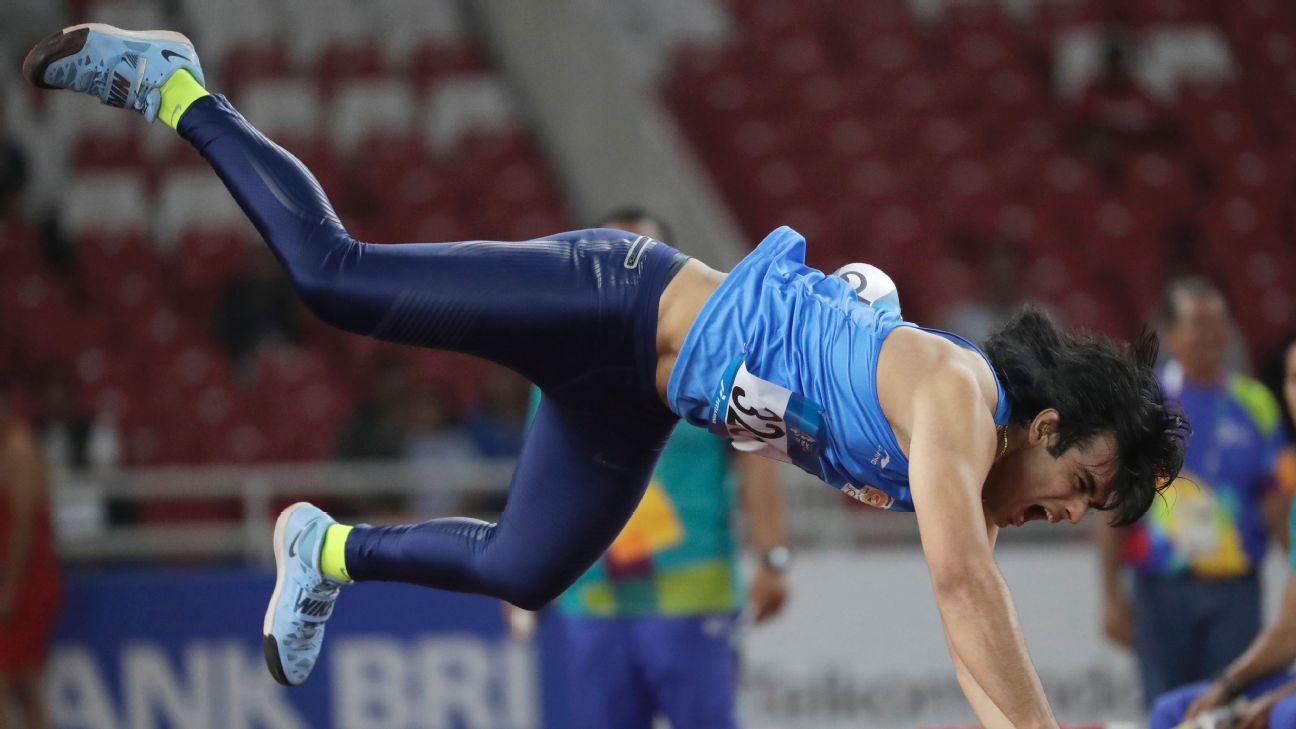
On Tuesday this week, javelin thrower Neeraj Chopra posted a short video clip of a practice session on his Instagram page. “86.26, 86.87, 87.25, 84.90 First time over 85 in training” is the caption of the six-second clip. The throws made at the National Institute of Sport in Patiala are particularly promising since the Indian says he has always thrown further in competition. But he doesn’t look like he’s getting any of that any time soon.
While Chopra has no option for now but to be satisfied with his training throws in an empty field, the rest of the world’s throwers are heading back to full competition mode. India’s struggle with the second wave of the COVID-19 pandemic has meant that even with a little over two months to go to the Tokyo Olympics, the country’s athletes are struggling to get crucial competition.
On Sunday, the IAAF Diamond League – the top tier one-day meet of the World Athletics calendar – will be held in Gateshead, UK. The men’s javelin throw field features eight of the world’s best throwers, including 2012 Olympic champion Keshorn Walcott and 2019 World Champion Anderson Peters. Johannes Vetter won’t be there, but that is out of choice. On Friday, the German threw a massive 93.20m at the Anhalt 2021 tournament in Dessau, Germany — three days after recording an even bigger throw of 94.20m at the Golden Spike meet in Ostrava.
With its high quality field, the Diamond League is an important tournament, one Chopra — perhaps India’s best bet for a maiden athletics medal at the Olympics — would have been hoping to take part in. The CWG and Asian Games champion, who is second only to Vetter this year, has spoken of the need to get high-level competition previously. “If we want to check our levels ahead of the Olympics, we have to compete against the guys who will be competing in the Olympics. If we think that we just have to train here and we will give our 100 percent at the Olympics, then it will be hard,” he had said a couple of weeks ago, shortly after a long-planned training camp in Turkey had to be cancelled at the last minute.
Chopra, who took part in the Indian GP and Federation Cup in March, but last competed internationally in January last year, isn’t the only athlete who is missing out. “[The] travel ban is a concern. I am not able to compete or train with the Olympic-bound athletes of different countries,” says long jumper MR Sreeshankar, who qualified for the Olympics with a national record of 8.25m in the Federation Cup this year.
In the case of Avinash Sable, India’s record holder in the 3000m steeplechase event, even luck wasn’t in his favour. Although he got permission to train in Kenya, he tested positive for the COVID virus just prior to his departure.
It’s not just the Olympic qualified athletes who are facing the strain.
While Chopra and Sreeshankar had met the Olympic qualifying standard, several Indian athletes were looking to qualify either through qualification tournaments or by performing consistently enough in order to earn ranking points.
“Everyone needs competition – the last 1-2 months is the real peaking period. If you are going to compete at the Olympics, you need competition to build to that. If you are taking part in the highest level of events, that is needed. It’s a huge issue,” admits Adille Sumariwala, the president of the Athletics Federation of India. “Till the second wave happened, we were fine. We had wanted our athletes to take part in the world relays, we had wanted them to train abroad and compete abroad. We had already made arrangements and all that has been messed up. A lot of our athletes are on the verge of qualifying or have qualified but they need to compete,” he says.
While every sport has been affected, the athletics program has been hit harder than others. The Indian boxing team got clearance at the last minute to compete at the Asian Championships in Doha, a competition that was originally to be held in India prior to the second wave of the Covid-19 virus. India’s wrestlers are expected to take part in the Poland Ranking series next month. Indian shooters too will be competing in the MQS category of the European Championships after travelling to Croatia by chartered flight for a training camp.
Sumariwalla, though, says the same was not possible for the athletics contingent. “The shooting team going to Croatia made sense because the European championships were happening there itself.” For athletics however, the events are spread across nations. “It’s not even a problem of whether we can get visa,” he says. “Even if a country allows us in, some training facilities won’t.” He also speaks about the need to send trainers and physios along with the athletes, which makes it more complex. “Today there are no flights going out. You can have a visa but there are no flights. It’s not straightforward. The goalposts are being shifted every other day,” he says.
Sumariwala says there’s little option but to wait and watch. “Even after the final qualification is announced (on June 29), if there is an opportunity to go and compete outside, we will still send athletes. That will still be important,” he says. Although the Federation has planned to hold three tournaments in India prior to the Olympics, it remains to be seen just how that is managed in light of extended lockdown periods across the country.
The Gateshead Diamond League was particularly crucial for Chopra since it’s one of only two Diamond League events that feature the javelin throw competition. He is hoping now to take part in the Doha Diamond League, scheduled for May 28. Should that fall through, he will likely have to fall back on simulating competition to the best of his abilities on the training field.